Real Estate

Real estate isn’t just about property — it’s about possibility. We help real estate brands define their purpose, elevate their identity, and communicate with clarity and conviction — so they inspire confidence, build trust, and connect meaningfully with investors, buyers, and communities.

Real estate branding is often treated as a layer that comes in once the project is ready to be sold. A name, a logo, a campaign, and a launch. But in reality, brand begins much earlier. It starts with how a developer thinks about the space they are creating and the life that will unfold within it. Long before the first visual is designed, the brand is already taking shape in decisions around location, design, amenities, and intent. What gets built is only part of the story. What it means is what people remember.

In this category, trust carries more weight than anything else. Buyers are not making quick decisions. They are investing in something that will shape their lives or their portfolios for years. Every touchpoint becomes a signal. The way a project is presented, the clarity of communication, the consistency across channels. These details quietly answer a deeper question in the buyer’s mind. Can I rely on this developer to deliver what is promised.

Many projects rely heavily on features and specifications. They speak about square footage, finishes, and payment plans. While all of that matters, it rarely creates differentiation. Most developments begin to sound the same. Branding steps in to create meaning beyond the numbers. It frames the project within a larger narrative. It helps people see not just what they are buying, but why it fits into their lives. Without that layer, even well designed projects can struggle to stand out.

The sales journey in real estate is long and often complex. It moves across digital platforms, showrooms, site visits, and personal interactions. Each stage shapes perception in a different way. If the experience feels disconnected, confidence starts to slip. When it feels aligned, the brand begins to build momentum. It reassures buyers at every step, making the decision feel clearer and more natural over time.

There is also an emotional dimension that cannot be ignored. For end users, this is about home, belonging, and identity. For investors, it is about confidence, growth, and security. A strong real estate brand understands both. It knows when to speak to aspiration and when to speak to logic. It balances the two without leaning too far in either direction. This balance is what makes a project feel both desirable and dependable.

At its best, real estate branding creates belief before construction is complete. It allows people to imagine a future that feels tangible, even when it is still being built. It brings clarity to complexity and confidence to uncertainty. For developers who understand this, branding is not an afterthought. It becomes a core part of how projects are conceived, communicated, and ultimately chosen.
Nugaal

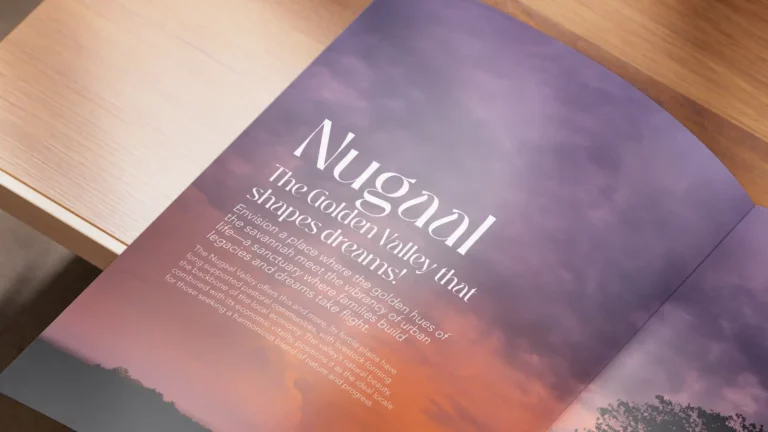
In Somalia’s evolving real estate landscape, housing developments have traditionally focused on functionality rather than community design. While demand for secure, modern living has grown—particularly among diaspora investors and upwardly mobile families—the concept of master-planned, self-sustaining communities remains rare. Located in the promising Nugaal Valley, a new townhouse development sought to redefine residential standards. But to introduce a new way of living in an emerging market, the brand needed to communicate more than square footage and amenities. Nugaal was envisioned as a self-sustaining residential community — one that would bring international quality of life standards to Somalia. To succeed, it required a brand that could translate ambition into belief.

Read MoreNugaal

Blanco Thornton

In a saturated UAE real estate market dominated by legacy developers and loud luxury claims, differentiation has become increasingly difficult. Many property brands rely on predictable visuals, interchangeable messaging, and transactional sales language. Blanco Thornton entered this competitive landscape with strong ambition and serious development intent — but without a distinct identity system to support its growth. To compete meaningfully in a design-conscious, investor-driven environment, the brand needed clarity, cohesion, and character.

Read MoreBlanco Thornton

Viani

As Dubai expands outward, emerging residential districts are redefining how communities form. Areas like Liwan are evolving into the city’s next growth corridors — offering accessibility, infrastructure potential, and room for long-term value appreciation. Yet in newly developing communities, perception is fragile. Buyers and investors look for confidence signals. Early projects must establish credibility not just for themselves, but for the district. When Meteora Developers prepared to launch its first project outside Jumeirah Village Circle (JVC), the move represented more than geographic expansion. Viani marked a new chapter.

Read MoreViani

Tissoli

In the UAE’s ultra-competitive luxury real estate market, the word “luxury” has become diluted. Developers frequently rely on gold accents, grand promises, and overused superlatives to signal prestige. Yet true luxury is no longer defined by embellishment — it is defined by curation, discretion, and architectural integrity. Into this saturated landscape entered Tissoli — a developer with the ambition to become the go-to name in refined, high-end living. To achieve that ambition, Tissoli required more than a logo. It required a brand with authority.

Read MoreTissoli

Crystal Lagoon

In the global luxury property market, real estate brokerage has become increasingly digitized — yet visually indistinguishable. Many agencies rely on template-driven websites, overused luxury aesthetics, and generic portfolio displays. For high-net-worth individuals (HNWIs), however, property discovery is not transactional. It is curated, private, and experience-driven. Crystal Lagoon sought to position itself as an international luxury brokerage catering to discerning investors across borders. To attract a global HNWI audience, the brand required more than listings. It required presence.

Read MoreCrystal Lagoon

Emaad

In Somalia, the real estate sector has historically been driven by function over vision. While demand for quality housing has grown—particularly among returning diaspora and upwardly mobile locals—the market has lacked cohesive master-planned communities that meet international standards. Amid reconstruction and renewed economic optimism, a new generation of developers began emerging. Yet most brands relied on generic luxury cues, borrowed architectural language, and transactional messaging. Emaad Properties was founded with a different ambition: To introduce international standards of living to Somalia and become a renowned developer across East and West Africa. To achieve this, it required more than projects. It required a vision-led brand.

Read MoreEmaad

Vivanti

Jumeirah Village Circle (JVC) has become one of Dubai’s most active residential ecosystems — defined by rapid launches, investor-driven inventory, and intense competition. As the district matured, differentiation became increasingly difficult. Larger developments required stronger narratives. Scale alone was no longer enough. When Meteora Developers prepared to introduce its fifth project in JVC — and one of the largest in the district, comprising 500 units — the stakes were significantly higher. Vivanti was not simply another addition to the portfolio. It was a statement of scale.

Read MoreVivanti

Park Boulevard

In Dubai’s high-density residential zones, new developments compete in a crowded mid-market landscape. Projects often emphasize price, unit mix, and amenities — while lifestyle narratives remain interchangeable. Located in Jumeirah Village Circle (JVC), a rapidly growing community known for its accessibility and family appeal, Park Boulevard entered a market saturated with apartment launches. Yet while many developments focused inward — on interiors and facilities — few articulated the emotional value of proximity to green space. Park Boulevard required more than project marketing. It needed a living philosophy.

Read MorePark Boulevard