Corporate & B2B

Corporate brands shape industries. The strongest ones shape perception. We partner with ambitious B2B organizations to sharpen their positioning, clarify their value, and build brand systems that signal credibility at scale. In complex markets where decisions are rational and relationships are long-term, we create clarity that converts — and authority that endures.

Corporate and B2B branding rarely gets the spotlight it deserves. It is not loud, it is not impulsive, and it does not chase attention for the sake of it. Yet it quietly shapes decisions that move millions, sometimes billions. In boardrooms, across long email threads, in conversations that stretch over months, brand is often the deciding factor that no one openly acknowledges. It is the difference between being shortlisted and being remembered. It is what makes a company feel like a safe decision before the numbers are even discussed.

Most B2B companies still believe their work speaks for itself. They focus on capability decks, case studies, and technical superiority. All of that matters, but it is rarely enough. The truth is that even the most rational decision makers are guided by perception. They are looking for confidence, clarity, and a sense that the company they choose understands more than just the brief. Branding is what translates competence into trust. It turns a service provider into a partner.

The complexity of B2B branding lies in its layered audience. You are not speaking to one person. You are speaking to procurement teams, technical evaluators, finance heads, and leadership. Each one comes with a different lens, a different concern, and a different definition of value. A strong corporate brand does not try to speak louder. It speaks sharper. It aligns its message so clearly that every stakeholder finds their own reason to believe, without the story feeling fragmented.

Consistency plays a deeper role here than in most consumer categories. In B2B, every touchpoint is under scrutiny. A website, a proposal, a LinkedIn post, a sales conversation. They all need to feel like they come from the same mind. When they do not, doubt creeps in. When they do, the brand begins to feel dependable. Over time, that dependability becomes a competitive advantage that is hard to replicate, because it is not built overnight.

There is also a quiet emotional layer that many overlook. Behind every corporate decision is a personal risk. Someone is putting their name behind a recommendation. Someone is accountable if things go wrong. A strong brand reduces that perceived risk. It gives decision makers a sense of assurance that goes beyond data. It tells them they are making a choice that others will respect. In that sense, B2B branding is not just about companies. It is about the people within them.

At its best, corporate branding does not try to impress. It tries to resonate. It does not rely on exaggeration or noise. It builds a clear, confident narrative that holds steady across time. For companies that get this right, growth starts to feel less like a chase and more like a natural progression. Opportunities become warmer. Conversations become easier. And the brand begins to do what it was always meant to do, which is to create belief before the first meeting even begins.
Blanco Thornton

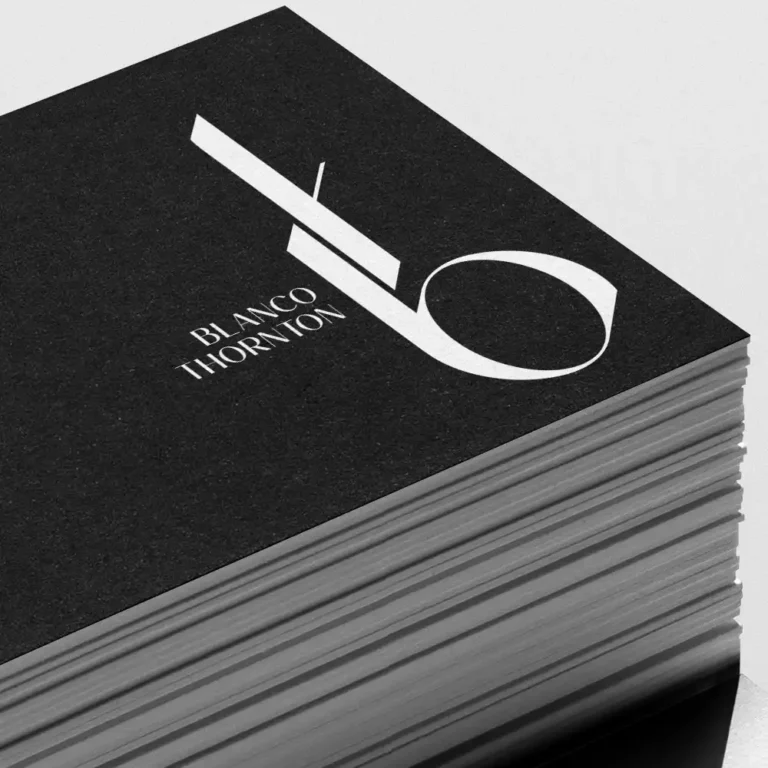
In a saturated UAE real estate market dominated by legacy developers and loud luxury claims, differentiation has become increasingly difficult. Many property brands rely on predictable visuals, interchangeable messaging, and transactional sales language. Blanco Thornton entered this competitive landscape with strong ambition and serious development intent — but without a distinct identity system to support its growth. To compete meaningfully in a design-conscious, investor-driven environment, the brand needed clarity, cohesion, and character.

Read MoreBlanco Thornton

Skyline

In the UAE’s rapidly vertical urban landscape, facilities management companies operate behind the scenes. While skyscrapers define city identities, the brands responsible for maintaining them often remain invisible. The façade cleaning sector, in particular, is highly technical, compliance-driven, and operationally complex — yet branding within the industry is typically generic, utilitarian, and interchangeable. Skyline entered the market with a clear ambition: To become the most trusted name in façade cleaning. However, to earn recognition in a crowded, specification-led industry, the company needed more than capability. It needed a distinct identity.

Read MoreSkyline

NuLumenTek

In the lighting and electrical technology sector, brands often communicate through technical specifications rather than identity. Product catalogs dominate. Visual language is secondary. Differentiation is minimal. Yet as smart infrastructure, architectural lighting, and energy-efficient systems become increasingly central to modern developments, perception matters more than ever. NuLumenTek operated in this technically driven environment, delivering advanced lighting and electrical solutions. However, its brand presence did not fully reflect the sophistication of its offering. The company required evolution — not reinvention.

Read MoreNuLumenTek

RAI

In industrial manufacturing and trading, longevity often equals credibility. Yet as regional players expand into global markets, heritage alone is no longer enough. International buyers expect clarity, sophistication, and strategic positioning. Rakha Al Khaleej International had nearly four decades of operational history — built on trust, technical reliability, and regional partnerships. However, as the company prepared to make its mark internationally, its brand identity did not fully reflect its scale or ambition. The leadership believed that a new global identity might be required.

Read MoreRAI

BGS

In the barcode and enterprise technology sector, functionality often overshadows branding. Companies compete on hardware specifications, distribution strength, and pricing — while visual identity and communication remain secondary. Yet as digital transformation accelerates across logistics, retail, warehousing, and manufacturing, perception matters. Enterprise clients increasingly look for partners who project clarity, innovation, and long-term reliability. Barcode Gulf Solutions (BGS) had built a strong operational reputation in the region. However, its brand identity no longer reflected its scale, maturity, or technological capability. The company required evolution — not reinvention.

Read MoreBGS

Telematics

Telematics was acquired by the Bahri & Mazroei Group in 2011 and is run by industry veterans bringing their experience and strong partnership with leading brands such as Cisco, Huawei, HPE (Aruba), NEC, Mitel, Interel, VingCard, Lutron, etc. and has been part of various iconic milestones and landmarks of UAE, like Burj Al Arab, Madinat Jumierah, Dubai Marina Mall, The Address Hotel Dubai, Qasr Al Sarab, Cleveland Clinic, Iranian Hospital, Dubai Parks and Resorts, Blue Waters and many more.

Read MoreTelematics