Tagline Development

Tagline Development at Red Marrow distills branding into its most concise and powerful expression. In a competitive market like Dubai, a tagline must capture positioning, ambition, and emotional resonance in just a few words. We craft strategically grounded lines that are memorable, defensible, and aligned with long-term brand direction — not fleeting campaign ideas. When developed with clarity and precision, a tagline becomes a lasting brand signature, reinforcing recognition and strengthening equity across every touchpoint.
Nugaal

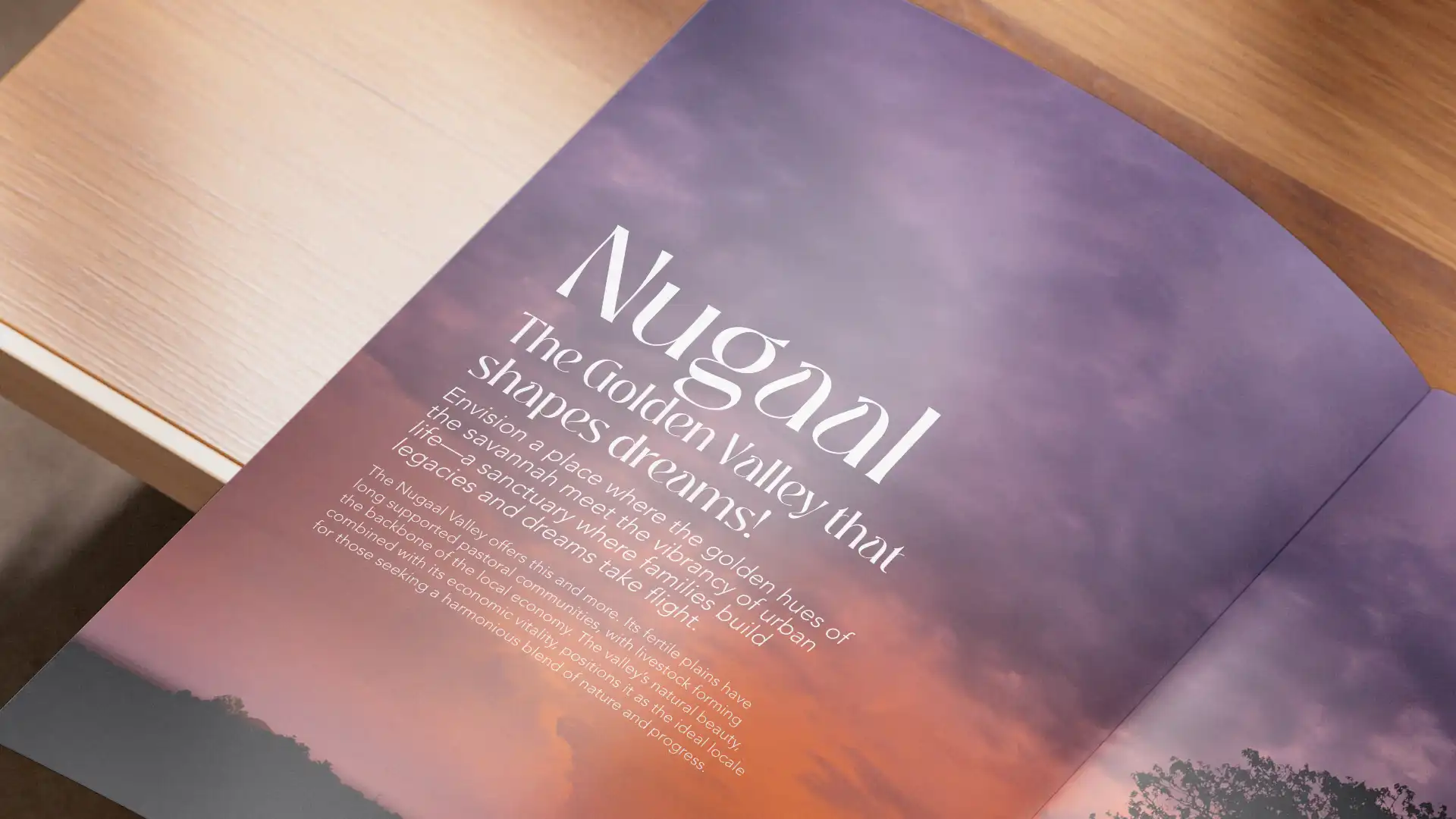
In Somalia’s evolving real estate landscape, housing developments have traditionally focused on functionality rather than community design. While demand for secure, modern living has grown—particularly among diaspora investors and upwardly mobile families—the concept of master-planned, self-sustaining communities remains rare. Located in the promising Nugaal Valley, a new townhouse development sought to redefine residential standards. But to introduce a new way of living in an emerging market, the brand needed to communicate more than square footage and amenities. Nugaal was envisioned as a self-sustaining residential community — one that would bring international quality of life standards to Somalia. To succeed, it required a brand that could translate ambition into belief.

Read MoreNugaal

Blanco Thornton

In a saturated UAE real estate market dominated by legacy developers and loud luxury claims, differentiation has become increasingly difficult. Many property brands rely on predictable visuals, interchangeable messaging, and transactional sales language. Blanco Thornton entered this competitive landscape with strong ambition and serious development intent — but without a distinct identity system to support its growth. To compete meaningfully in a design-conscious, investor-driven environment, the brand needed clarity, cohesion, and character.

Read MoreBlanco Thornton

Skyline

In the UAE’s rapidly vertical urban landscape, facilities management companies operate behind the scenes. While skyscrapers define city identities, the brands responsible for maintaining them often remain invisible. The façade cleaning sector, in particular, is highly technical, compliance-driven, and operationally complex — yet branding within the industry is typically generic, utilitarian, and interchangeable. Skyline entered the market with a clear ambition: To become the most trusted name in façade cleaning. However, to earn recognition in a crowded, specification-led industry, the company needed more than capability. It needed a distinct identity.

Read MoreSkyline

Tissoli

In the UAE’s ultra-competitive luxury real estate market, the word “luxury” has become diluted. Developers frequently rely on gold accents, grand promises, and overused superlatives to signal prestige. Yet true luxury is no longer defined by embellishment — it is defined by curation, discretion, and architectural integrity. Into this saturated landscape entered Tissoli — a developer with the ambition to become the go-to name in refined, high-end living. To achieve that ambition, Tissoli required more than a logo. It required a brand with authority.

Read MoreTissoli

Maisour

In the GCC, property ownership has long been aspirational — yet financially exclusionary. Real estate is culturally revered, but structurally inaccessible to younger investors. Maisour entered the market with a radical proposition: Own real estate fractionally. Invest digitally. Start small. But the category faced deep skepticism: Can fractional ownership be trusted? Is digital property investment secure? Is this real estate — or just another fintech promise? Maisour required more than branding. It required belief.

Read MoreMaisour

NuLumenTek

In the lighting and electrical technology sector, brands often communicate through technical specifications rather than identity. Product catalogs dominate. Visual language is secondary. Differentiation is minimal. Yet as smart infrastructure, architectural lighting, and energy-efficient systems become increasingly central to modern developments, perception matters more than ever. NuLumenTek operated in this technically driven environment, delivering advanced lighting and electrical solutions. However, its brand presence did not fully reflect the sophistication of its offering. The company required evolution — not reinvention.

Read MoreNuLumenTek

Meteora Developers

Dubai’s real estate market is one of the most brand-conscious property ecosystems in the world. Developers compete not only through architecture and payment plans, but through identity, perception, and visibility. In such a landscape, a weak brand does not merely underperform — it disappears. As Meteora Developers prepared to enter the market with multiple launches in Jumeirah Village Circle (JVC), the company’s existing brand lacked clarity, authority, and memorability. The projects had potential. The brand did not.

Read MoreMeteora Developers

RAI

In industrial manufacturing and trading, longevity often equals credibility. Yet as regional players expand into global markets, heritage alone is no longer enough. International buyers expect clarity, sophistication, and strategic positioning. Rakha Al Khaleej International had nearly four decades of operational history — built on trust, technical reliability, and regional partnerships. However, as the company prepared to make its mark internationally, its brand identity did not fully reflect its scale or ambition. The leadership believed that a new global identity might be required.

Read MoreRAI

BGS

In the barcode and enterprise technology sector, functionality often overshadows branding. Companies compete on hardware specifications, distribution strength, and pricing — while visual identity and communication remain secondary. Yet as digital transformation accelerates across logistics, retail, warehousing, and manufacturing, perception matters. Enterprise clients increasingly look for partners who project clarity, innovation, and long-term reliability. Barcode Gulf Solutions (BGS) had built a strong operational reputation in the region. However, its brand identity no longer reflected its scale, maturity, or technological capability. The company required evolution — not reinvention.

Read MoreBGS

Elements by MEYCI

Dubai’s fashion retail landscape is defined by two extremes: global luxury houses and fast-fashion chains. While both dominate mall corridors, there remains a gap for curated concept stores that bring emerging European trends directly to style-conscious consumers. As fashion becomes increasingly globalized through social media, Dubai’s audience — especially young, cosmopolitan shoppers — no longer waits for seasonal diffusion. They seek immediacy, discovery, and exclusivity. Into this environment emerged a new retail vision. Elements by MEYCI aimed to introduce trending European fashion directly to Dubai — not through mass retail, but through curated expression. The concept required a name, a philosophy, and a visual world.

Read MoreElements by MEYCI